
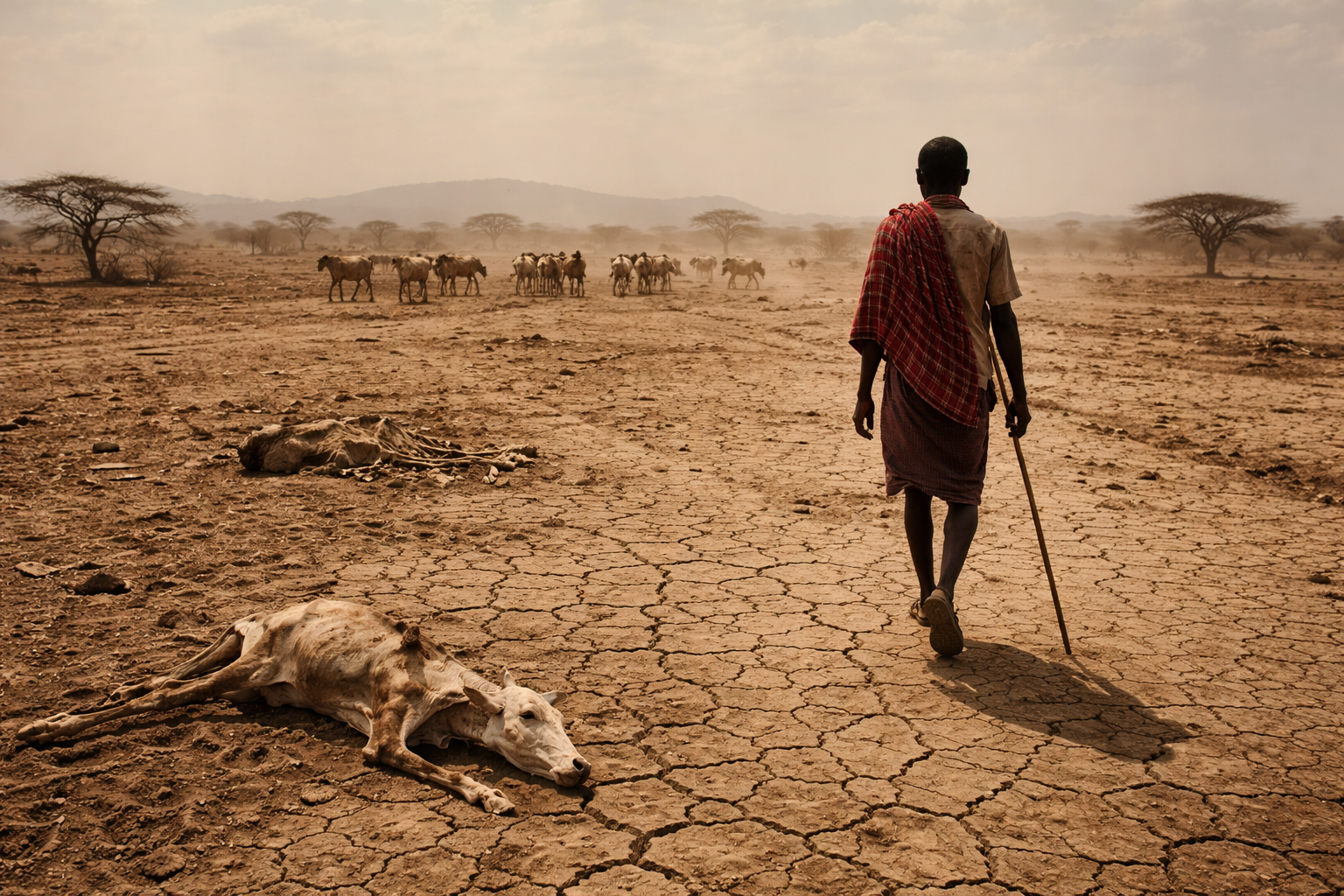
The cracked, exhausted soils of Kenya’s drylands do not just cradle the carcasses of the 2.5 million livestock lost during last drought season. It holds the broken futures of families whose wealth, dignity, and security were buried with those animals.
When we speak of KSh 50 billion in livestock losses, it is not a routine economic setback. It is the slow-motion collapse of a pastoralist economy that has sustained Kenya’s drylands for centuries.
For a pastoralist in Turkana, Marsabit, Isiolo, or Wajir, a cow is not merely meat on the hoof. It is a savings account, a child’s school fees, an emergency medical fund, and a dowry. Livestock is the backbone of household stability.
When millions of these living assets disappear under the weight of climate-driven drought, the result is not only poverty—it is a forced, silent transfer of wealth from some of Kenya’s poorest families into the vast void created by policy gaps and climate inaction.
The High Price of Reactionary Governance
Kenya remains trapped in a predictable cycle of “crisis and compassion.” Livestock starve, cameras arrive, emergency appeals are launched—and short-term relief follows.
But the numbers from the 2022–2026 drought cycles tell a harsh truth: our response model is financially irrational and morally untenable.
The Cost of Inaction
Replacing 2.5 million dead livestock requires billions in restocking.
In the past three months alone, the government spent KSh 9 billion on drought response: KSh 2B in November 2025, 3B in December, and 4B in January 2026.
This is the accumulated bill for failing to allocate even the minimum KSh 2B annually required to prevent predictable livestock losses.
The Cost of Prevention
Investing in fodder reserves, early drought interventions, and reliable, climate-proof water system.
These critical interventions would cost only a fraction of what Kenya currently hemorrhages in emergency spending.
Let us be very clear:
The KSh 50 billion livestock loss was not an act of God. It was an act of unpreparedness.
Kenya has the science and early-warning systems to predict droughts months ahead. Yet we still fail to move fodder, water, and veterinary support to where they are needed when they are needed.