
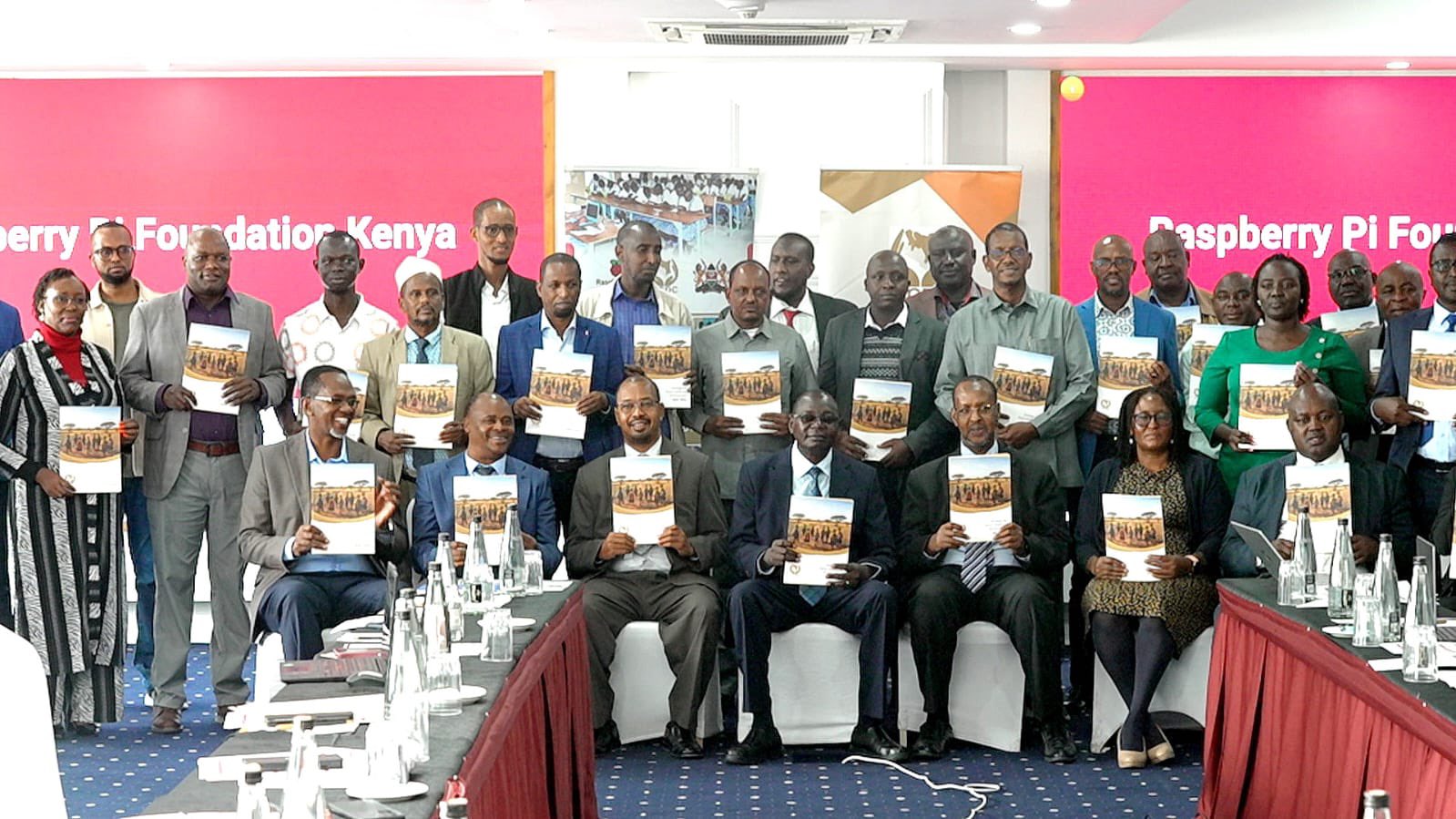
The Frontier Counties Development Council (FCDC), in partnership with the Raspberry Pi Foundation, convened the 2nd Digital Learning Coordination and Reflection Meeting in Nairobi, bringing together key education stakeholders from across the Frontier region.
The forum assembled national government officials, Regional Education Teams, County Education Teams, and ecosystem partners including the Aga Khan Institute for Human Development to reflect on three years of advancing digital learning across frontier counties.
Presiding as Chief Guest, James Lowasa, Deputy Governor and CECM for Education in Isiolo County, affirmed that digital learning has moved beyond pilot discussions and is now firmly embedded as a governance commitment.
He underscored the need for clear budget lines, strong policy alignment, sustained intergovernmental coordination, and full institutionalisation of digital learning systems across counties.
Representing the Raspberry Pi Foundation, Wariara Waireri, Africa Lead for Partnerships and Ecosystem, reflected on the journey from what began as a bold idea into a structured and expanding, government-led ecosystem.
She noted a visible shift toward increased county and national ownership, with partners such as UNICEF and EIDU continuing to provide complementary support spanning pre-primary through junior school levels.
Speaking on behalf of Regional Directors, James Ndimuli, Regional Director of Education for Rift Valley, commended the Frontier model and reaffirmed commitment to ICT integration in line with the priorities of the Ministry of Education.
The meeting reviewed progress made over the past three years, consolidated lessons learned, strengthened alignment between national policy and County Integrated Development Plans (CIDPs), and reinforced coordination between regional and county education teams. It also formally ushered in the FCDC Early Childhood Development Strategic Plan 2025–2030.
From pilot to ecosystem. From project to policy. From innovation to institutionalization.
The Frontier region continues to demonstrate that with coordinated leadership and sustained commitment, digital transformation in education is not aspirational, it is achievable.