
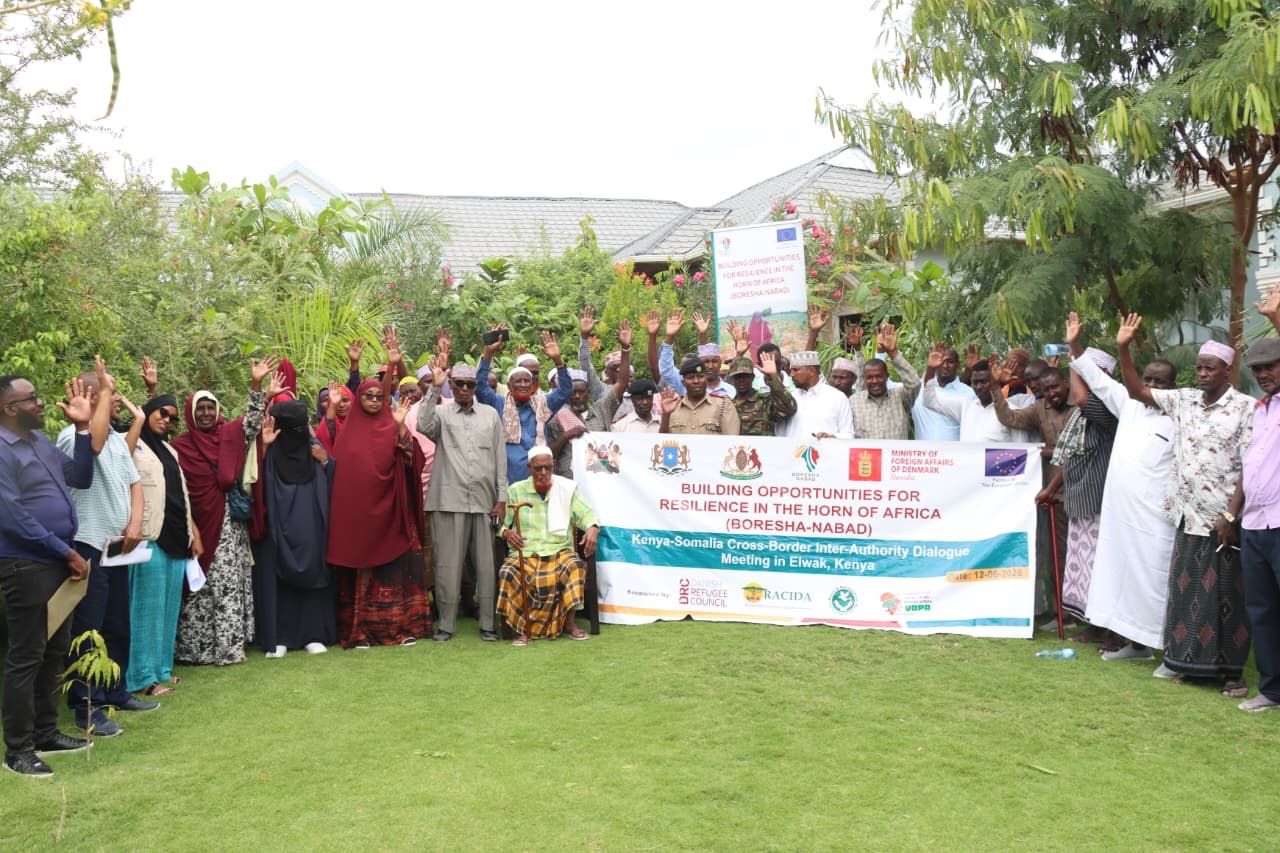
Community elders, women, youth leaders and government authorities from Kenya, Somalia and Ethiopia have successfully brokered peace agreements in two separate cross-border conflicts, demonstrating the power of locally led dialogue in preventing violence and restoring stability across the Mandera Triangle.
Facilitated under the BORESHA-NABAD Programme, the peace engagements brought together rival communities following incidents that had threatened to escalate into wider cross-border conflicts.
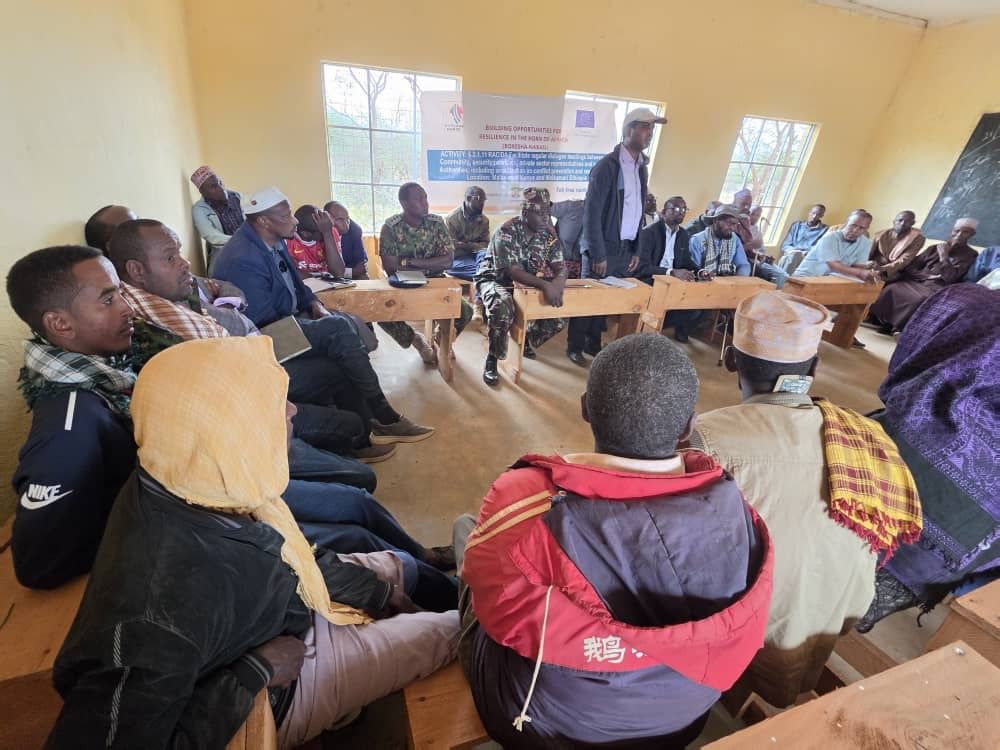
The dialogues, supported by the European Union and Danida, reaffirmed the critical role of community leadership in resolving disputes through dialogue, reconciliation and non-violent action.
The first intervention took place in Elwak, Kenya, and Celwaq, Somalia, where a three-day peace dialogue was convened following deadly clashes between the Garre and Marehan communities that claimed four lives and heightened tensions across the border.
The dialogue brought together elders, county and national government representatives from both Kenya and Somalia, religious leaders, women and youth representatives with the shared objective of ending hostilities and restoring peaceful coexistence.
Jointly facilitated by BORESHA-NABAD consortium partners DRC Kenya, RACIDA, VOPA NGO, and MWFPD, the engagement provided a platform for both intra-community and inter-community discussions, allowing participants to openly address grievances and agree on practical solutions.
The dialogue produced several key resolutions, including the immediate cessation of hostilities, community-led identification of those responsible for the violence, and a joint commitment by Kenyan and Somali authorities to apprehend the perpetrators.
The parties also reached consensus on blood compensation arrangements, restored calm between the affected communities, enabled displaced families to begin returning home, and facilitated the reopening of schools that had been closed due to insecurity.
Community elders from both sides of the border were further mandated to oversee the implementation of the resolutions and ensure sustained peace within the affected communities.
In a separate peacebuilding initiative along the Kenya–Ethiopia border, BORESHA-NABAD successfully mediated tensions between the Garre and Degodia communities following an incident in which a young boda boda rider from the Degodia community was seriously injured and his motorcycle stolen in Malkamari, Ethiopia.
The unrest also resulted in damage to a community borehole serving residents on the Ethiopian side of the border.
Working through consortium partner RACIDA and in collaboration with the Mandera County Department of Community Cohesion and local authorities from Mubarak in Ethiopia and Banisa in Kenya, BORESHA-NABAD facilitated two sequential peace dialogues bringing together elders, conflict-monitoring committees, community representatives and government officials.
The initial dialogue focused on preventing further escalation, identifying the root causes of the conflict and securing an immediate ceasefire, while the follow-up engagement addressed outstanding issues relating to compensation and restoration of damaged community infrastructure.
The process resulted in an agreement to compensate the injured boda boda rider and provide KSh120,000 for the stolen motorcycle. The parties also agreed to jointly assess the damage to the borehole and implement measures for its restoration, ensuring continued access to water for affected communities.
Throughout both peace processes, community elders, women, youth leaders, conflict-monitoring committees and local authorities played a central role in mediating disputes, de-escalating tensions and building consensus around practical, community-owned solutions.
The successful outcomes underscore BORESHA-NABAD's continued commitment to strengthening locally led peacebuilding mechanisms across the Mandera Triangle, where cross-border communities frequently face shared security, environmental and livelihood challenges.
By creating platforms where communities can negotiate, reconcile and jointly address emerging conflicts, the programme is helping transform local peace structures into sustainable mechanisms for conflict prevention and social cohesion.
As communities on both the Kenya–Somalia and Kenya–Ethiopia borders continue to embrace dialogue over violence, the latest agreements offer renewed hope for lasting peace, improved cross-border relations and greater stability in one of the Horn of Africa's most strategically important regions.