
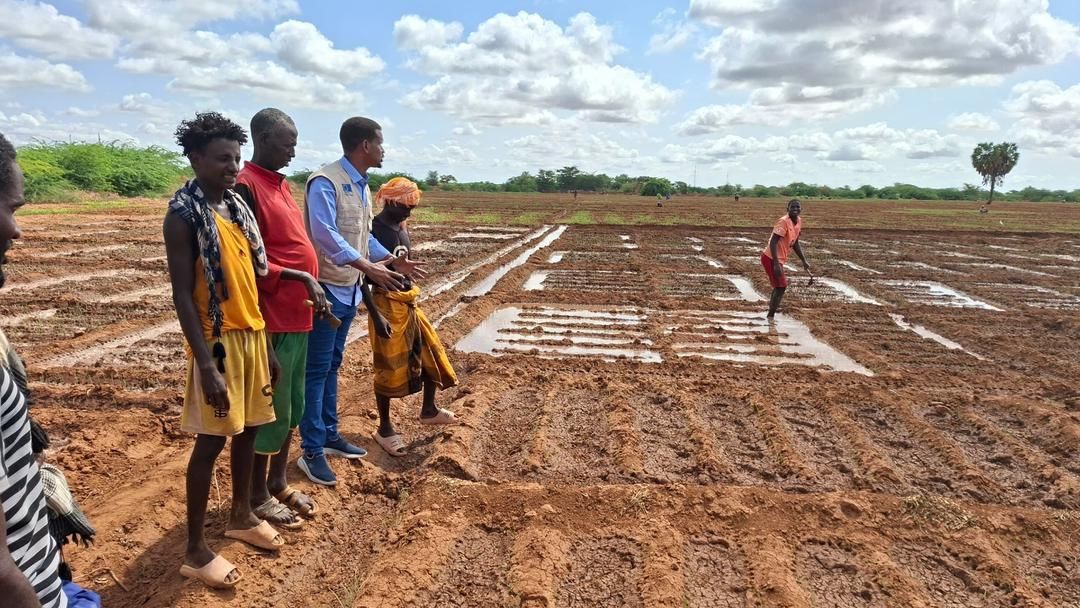
Farmers in Dollow are increasingly shifting from subsistence-based agriculture to coordinated, market-oriented production following improved access to irrigation and sustained support through the BORESHA-NABAD programme.
For years, agricultural production in Dollow was constrained by uneven access to irrigation, scattered land use, and limited coordination among farmers.
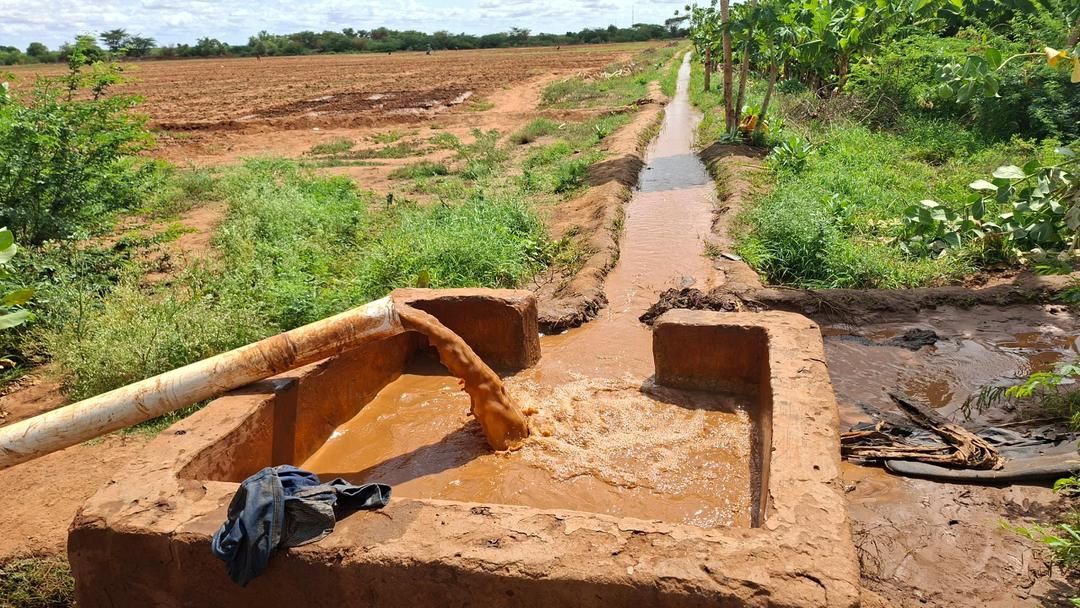
These challenges kept production largely at the household level, with weak incentives for farmers to plan, invest, diversify, or respond effectively to market demand.
However, recent programme investments in irrigation infrastructure, farmer organisation, and production coordination are beginning to transform farming practices in the area.
Through support delivered by DRC Somalia under BORESHA-NABAD, farmers have benefited from early system enablers such as solar-powered floating irrigation pumps, the reclamation of degraded riverine farmland, and the formation of cooperatives and local community investment group structures.
These interventions are now contributing to visible behavioural change, with farmers increasingly preparing land in a structured manner, coordinating labour through crop-sharing arrangements, and managing irrigation collectively across plots.
Farmers are also scaling into higher-value crops, including onions, in response to local market demand.
The expansion into such crops reflects growing confidence among producers and a stronger willingness to invest in agriculture as a viable livelihood.
Improved irrigation access has also enabled farmers to make better production decisions during the rainy season.
By balancing rainfall with solar-powered irrigation systems, they are managing water more efficiently and reducing risks linked to unpredictable weather conditions.
The BORESHA-NABAD programme has focused not only on infrastructure but also on strengthening relationships, coordination, and access to services.
Farmers have been linked to private agro-input suppliers, technical experts, and extension service providers to help them respond to opportunities within their production systems.
As a result, more farmers are taking the lead in expanding cultivated land and bringing additional acres under production.
This farmer-led land expansion signals growing confidence in the reliability of irrigation systems and the benefits of collective action.
The emerging model is also reducing reliance on external support as practices become locally sustained through cooperatives and shared resource management.
According to the programme, the changes point to stronger incentives for farmers to invest, plan, and diversify their production.
They also demonstrate a gradual shift from subsistence farming toward a more market-oriented agricultural system.
The developments in Dollow show that farmers are no longer only producing for survival but are actively coordinating, adapting, and making decisions based on water availability, shared resources, and market signals.
With improved irrigation systems and stronger farmer organisations, Dollow’s agricultural sector is positioning itself for more resilient, productive, and commercially responsive growth.